
Everything you need to know about the K2 Base Camp Trek
Raw, rugged, and remote, Pakistan’s K2 Base Camp trek promises the adventure of a lifetime. Climb through untamed wilderness, soaring peaks, and some of the most remote landscapes in the world.
But this is no ordinary trek. The epic journey through the Karakoram mountains is long, high, and physically demanding.
So, is this iconic high-altitude adventure right for you?
By the end of this article, you’ll know for sure. Our K2 trek guide covers itineraries, logistics, planning, preparation, and what to expect. We offer the complete lowdown to help you plan your trek to K2 Base Camp and figure out if it’s the right adventure for you.
What is the K2 Base Camp Trek?
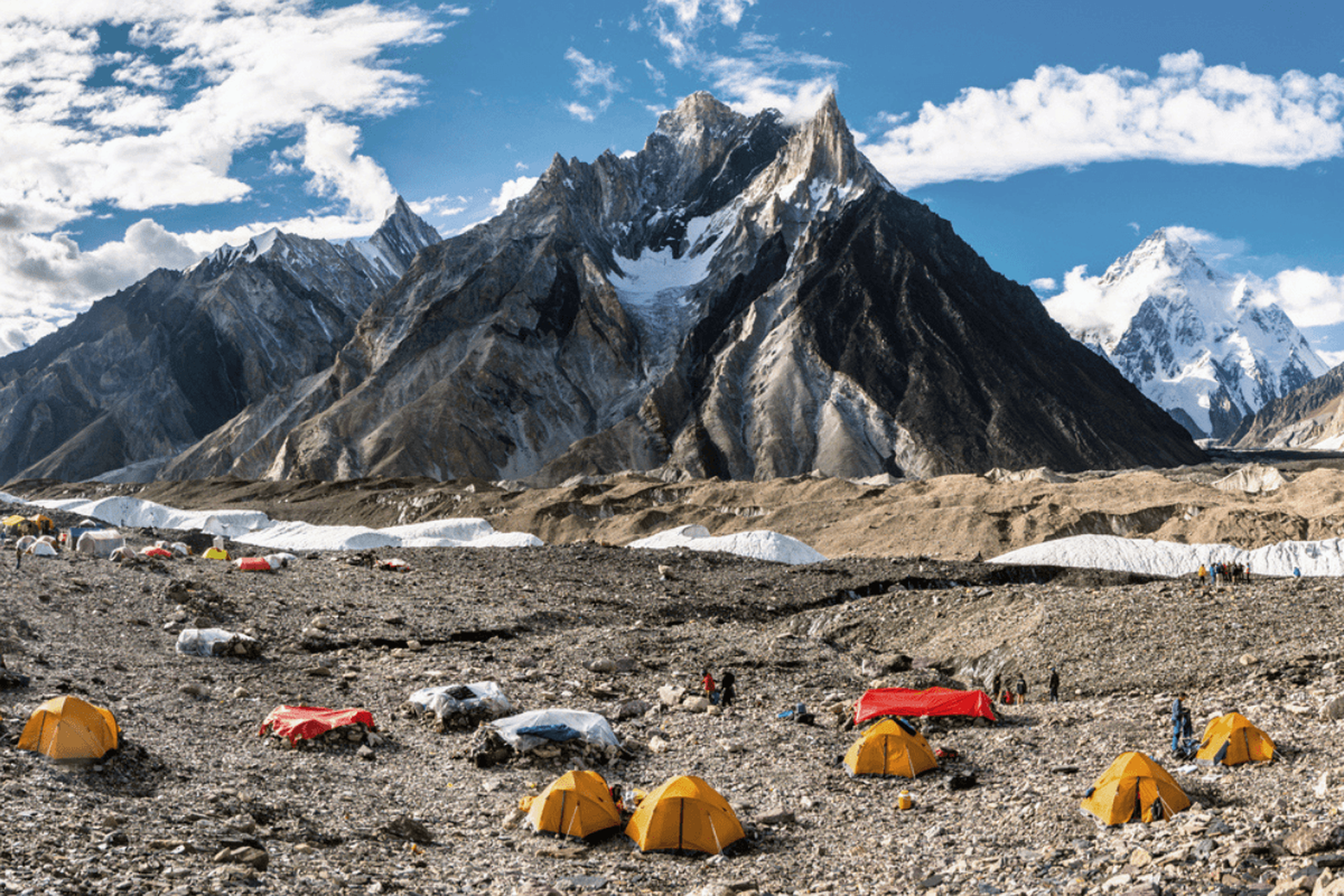
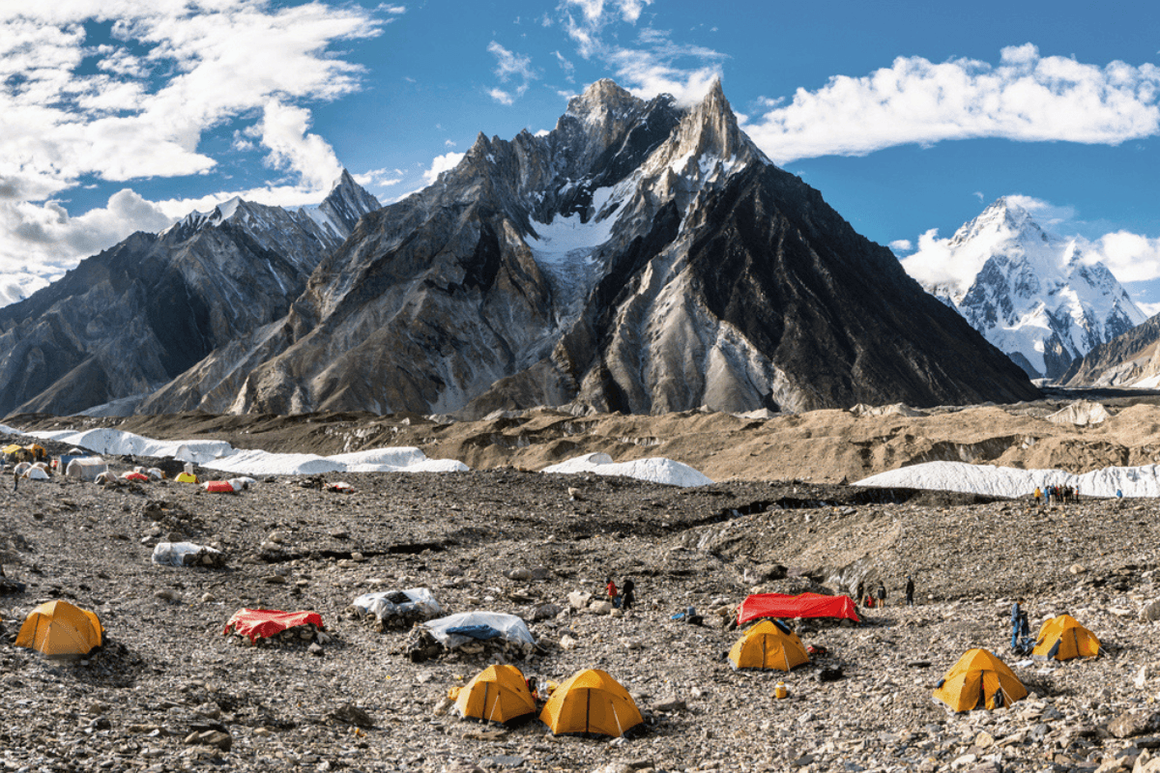
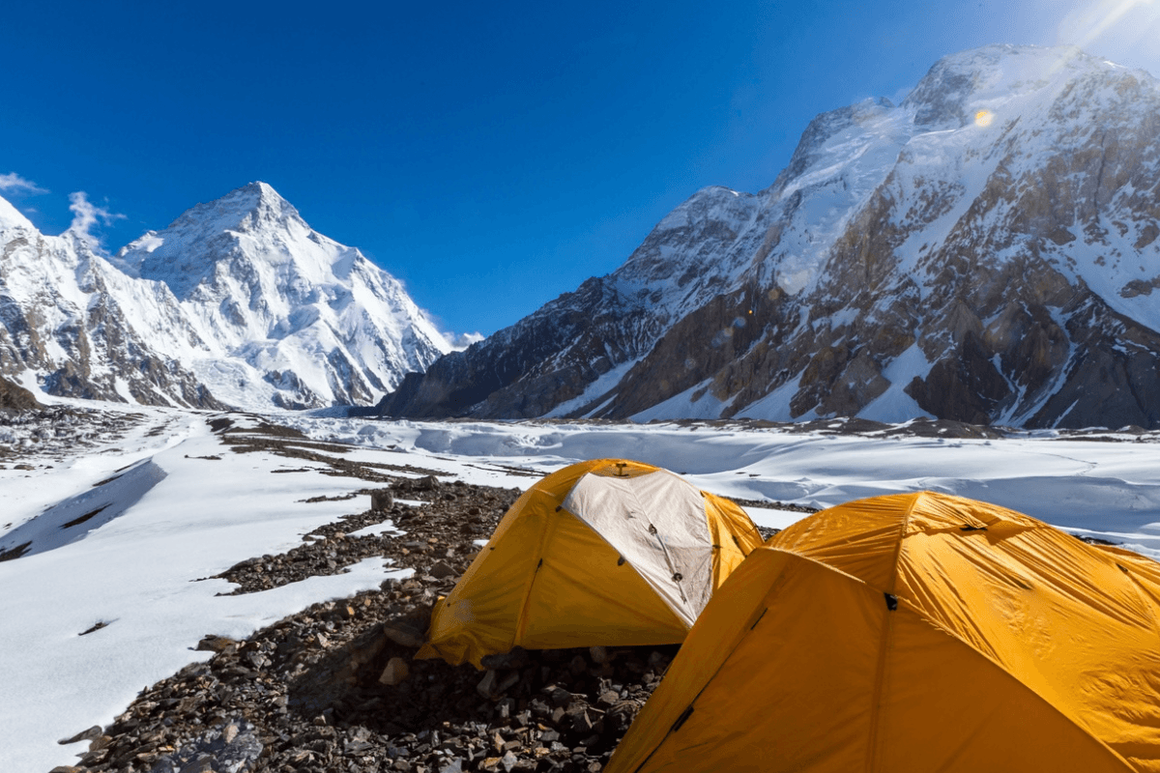
K2 is the second highest mountain in the world at 8,611m. K2 Base Camp sits at the base of the mountain, between 5,000 - 5,150m high. It’s not a fixed camp, with placements changing depending on ground conditions.
The trek to K2 Base Camp is an incredible adventure. Taking between 18-21 days and covering between 130-160km, it’s not an easy journey. Although no technical mountaineering skills are required, hiking on rough trails, through fast-flowing rivers, and over ancient glaciers demands a high level of fitness and stamina.
Surrounded by the stunning rocky spires of the Karakoram mountain range, K2 and K2 Base Camp are in Pakistan, a country covered two thirds in mountains. Pakistan is home to five of the 14 highest mountains in the world making it a paradise for high-altitude-loving explorers.
Oh, and it also boasts three of the world’s highest mountain ranges – the Karakoram, Hindukush, and Himalayas.
Compared to the Everest Base Camp trek, K2 Base Camp sits at a slightly lower altitude. But with unpredictable terrain, quieter trails, and basic facilities, K2 Base Camp appeals to thrill-seekers searching for a more challenging adventure.
Recommended reading: Find out more about how hard the K2 Base Camp trek really is.
Why K2 Base Camp ranks among the world's great treks
K2 Base Camp is one of the world’s greatest treks because it combines extraordinary high-altitude scenery with extreme remoteness, offering an unrivaled sense of adventure and achievement.
Here are a few of the highlights;
- K2 itself is widely regarded as the most difficult mountain in the world to climb. Reaching Base Camp gives spectacular views of this notorious 8,000m peak.
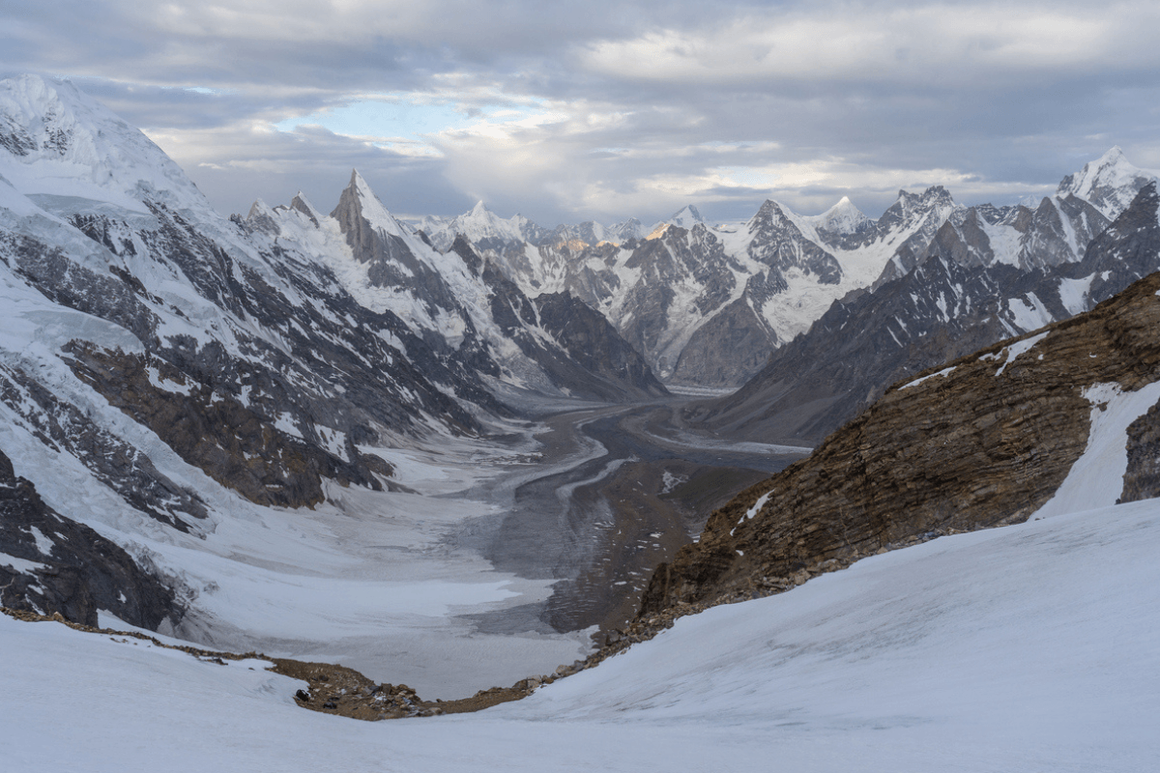
- The Karakorams have the most glaciers outside of the polar regions. In particular, the Baltoro Glacier is a major attraction as one of the largest non-polar glaciers in the world. Crossing glacial terrain, rivers, and crevasses is a particular draw of this trek.
- Navigating through rugged valleys, remote passes, and the towering rock faces of Earth’s highest mountains offers truly dramatic scenery. From the insane natural amphitheatre of Concordia spot K2, Broad Peak, Gasherbrum I, and Gasherbrum II.
- Between Broad Peak Base Camp and K2 Base Camp, pause at the Gilkey Memorial cairn – a moving tribute to those lost on K2.
- Immerse yourself in the Tibetan-influenced culture of the Baltistan region and enjoy the warm hospitality of the Balti mountain communities.
Physical demands and fitness requirements to climb K2 Base Camp
Unlike trekking to Everest Base Camp, where trails are carefully maintained, trekking to K2 Base Camp is a more technical and rugged undertaking. This means trekkers need a certain level of fitness and experience to successfully complete the trek.
Terrain
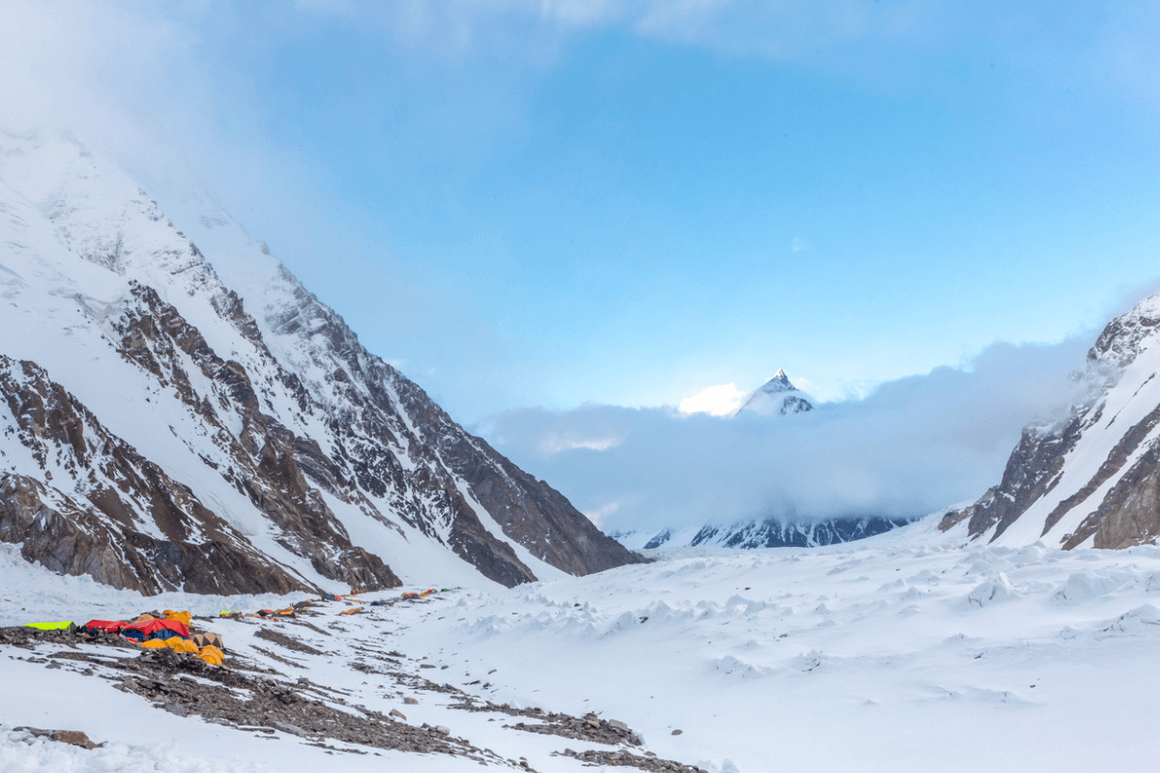
The mountain terrain can be uneven, loose, and steep. There are river crossings and bridges, narrow paths, and sheer drops. Owing to the variable and challenging nature of the route, a high level of fitness and trekking competence is required.
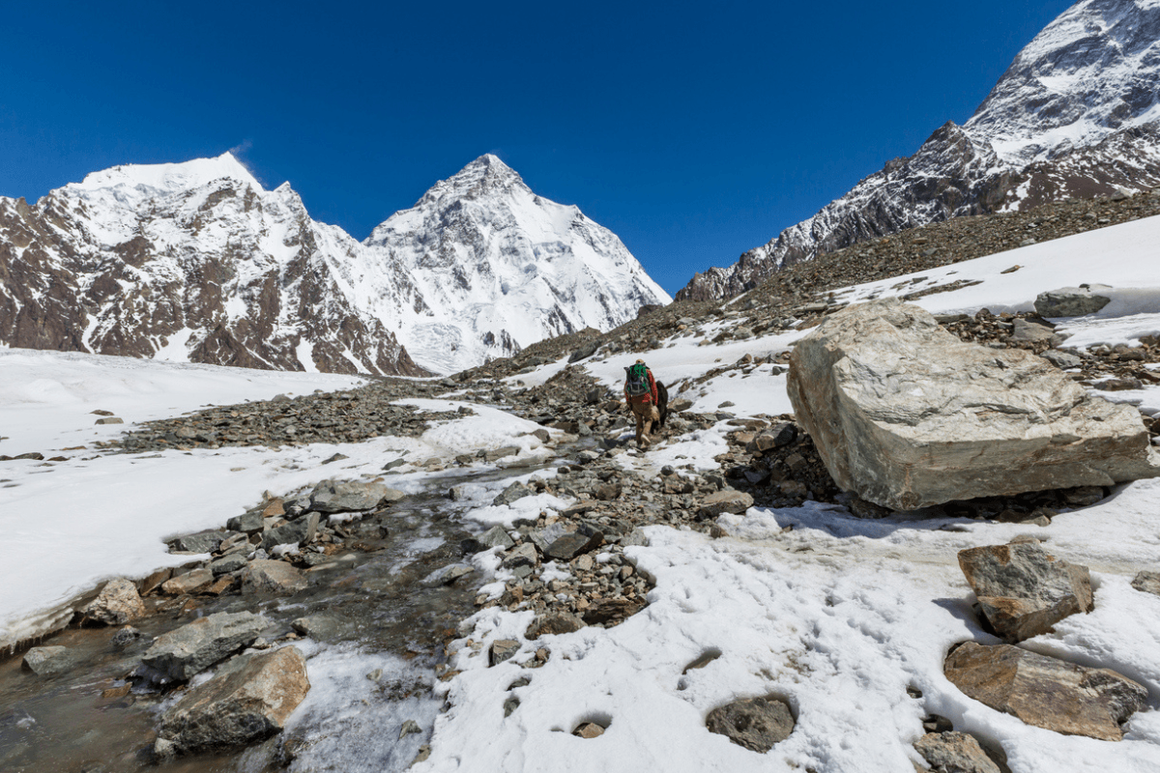
Loose rocks, scree, snow, and ice cover the way at times. With changeable conditions on the mountain, the route is rarely straightforward.
Trek duration and distance
Depending on which route is chosen, this journey is between 130-180km long and you may spend 8-10 hours a day walking on variable terrain. While there may be acclimatisation days in your itinerary, you’ll still need to walk all day on consecutive days.
Altitude
The success and comfort of this trek is down to how your body handles the altitude. Anyone can be adversely affected by altitude sickness, but experience of high altitude and good fitness can alleviate the worst symptoms.
Find a tour operator that includes acclimatisation days into the itinerary to ensure your body has time to get used to the progressively higher altitudes to keep symptoms to a minimum.
Conditions
One of the main reasons K2 is such a dangerous mountain to climb is the unpredictable weather. You may need to endure prolific rain, high winds, sun exposure, and cold temperatures, often all in the same day!
Careful layering, adequate protective clothing, and a knowledgeable guide are essential for enduring ever-changing conditions during your trek.
Training
Fitness training is also essential for this trip and only experienced trekkers should consider K2 Base Camp trekking. Training at altitude and carrying double your daypack weight on consecutive days will build aerobic capacity, cardiovascular fitness, and muscle memory.
The K2 Base Camp trek itinerary breakdown
The K2 Base Camp trek begins in Askole. International visitors usually fly into Islamabad (airport code PAA) and spend a day or two exploring Pakistan’s vibrant capital city.
From here, a short internal flight to Skardu takes approximately 1 hour, followed by a 6-hour drive to the village of Askole, around 3,000m high.
Askole – Jhole, 3,200m
Approximately 21km | 7-8 hours walking | Camp at Jhole
After an early start, the trek to Jhole (or Jhola) is a gentle one crossing the Biafo Glacier, multiple bridges, and taking in glimpses of rocky pinnacles and high peaks along the way.
Jhole – Paiju, 3420m
Approximately 20km | 7-8 hours walking | Camp at Paiju
Following the Braldu River, a decent path skirts the edge of the river (with several crossings required) before ascending to breathtaking views of the Baltoro Glacier, Paiju Peak, and Trango Towers.
Paiju – Khoburste 3,930m
Approximately 15km | 5-6 hours walking | Camp at Khoburste
An acclimatisation day at Paiju is built-in to many itineraries as there are basic facilities and running water here.
After resting tired legs and meal preparation for the days ahead, the route continues to find the edge of the Baltoro Glacier. Climbing onto the glacier, the next 2-3 days are spent walking on or beside it, as conditions allow.
Terrain here is challenging and alternates between undulating rock-covered glacier and the rocky moraine next to it.
Khoburste – Urdukas, 4,130m
Approximately 6km | 3-4 hours walking | Camp at Urdukas
A shorter day’s trekking follows the trek high-sleep low principle* to manage acclimatisation. The camp at Urdkuas sits on a ridge above the glacier with astounding views of the Trango Towers, Cathedral Peak and Lobsang (5,707m).
*You climb higher during the day, then descend to a lower altitude to sleep. Spending time at the higher elevation helps your body adapt to the altitude, while sleeping lower gives you more recovery time and reduces the strain of altitude exposure.
Urdukas – Goro, 4,350m
Approximately 12km | 7-8 hours walking | Camp at Goro
Ascending onto the glacier once again, this section traverses over rubble covered glacier with excellent views of Masherbrum (7,821m) and the Gasherbrums. At Goro, you’ll spend the first night camping on ice so beware of plunging temperatures and wrap up warmly.
Goro – Concordia, 4,500m
Approximately 12km | 4-5 hours walking | Camp at Concordia
The trek from Goro to Concordia passes the Mustagh Tower (7,284m), with spectacular views of Gasherbrum IV (7,925m), Gasherbrum II (8,035m), Broad Peak (8,051m), and K2 rewarding travellers on arrival at Concordia. A natural amphitheatre, Concordia is a glacial junction overlooked by four of the world’s highest mountains and an unforgettable place to experience.
Concordia – K2 Base Camp – Broad Peak Base Camp
Approximately 14km | 7-8 hours walking | Camp at Broad Peak Base Camp
Some itineraries spend the night at K2 Base Camp, while others ascend from Concordia and descend to Broad Peak Base Camp instead.
Setting out from Concordia, trekkers must negotiate crevasses, glacial melt rivers, and gritty ice. This is another challenging part of the route but well worth the effort for the panoramic views from Broad Peak Base Camp.
At this point, K2 Base Camp trek itineraries either return following the same out-and-back route, arriving in Askole in 4-5 days, or begin a circular route back via the Gondogoro Valley.
Route alternative
An alternative K2 Base Camp trek itinerary returns to Skardu via the Gondogoro La Pass which offers incredible views across the Gondogoro Valley, Gondogoro, and Trinity glaciers. This route requires a roped traverse with harnesses, helmets, and crampons.
No mountaineering experience is needed, but navigating the icy terrain can be treacherous so trekkers are roped together for safety.
After passing through Gondogoro, this circular route descends the lush Hushe valley to Dalsmpa, Saicho, and Hushe village before returning to Skardu by road.
K2 Base Camp trek cost
Expect to pay between £3,500 - £4,500 / $2,600 - $3,300.
Prices vary depending on route, itinerary, and inclusions. For a 21-day trip with internal flights, costs usually start around £4,000/$3,000. Allow extra money for tips, spending money and any excursions or additional nights accommodation before and after the trek.
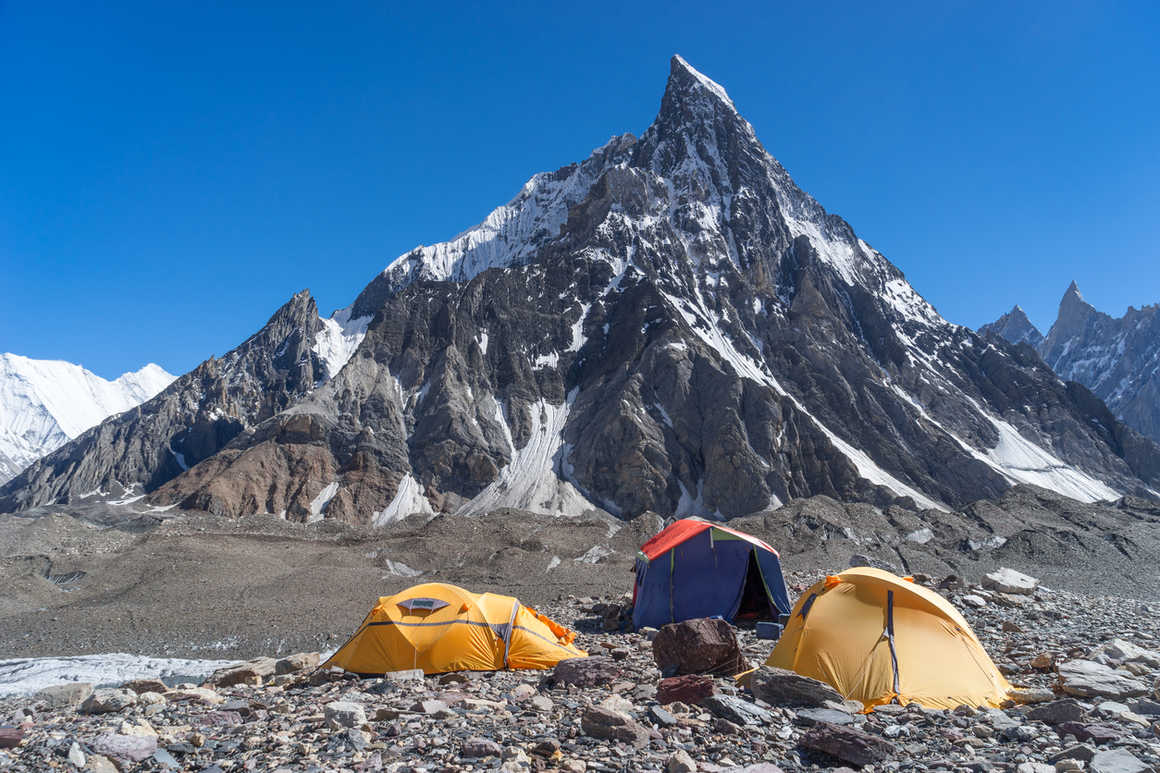
With no other accommodation options available during the trek, each K2 Base Camp tour is typically priced as an all-inclusive package. Pre-trek accommodation is usually in hotels or guesthouses whereas during the trip, porters will carry tents and camping equipment and set up temporary camps along the route.
Your trip cost will likely include:
- Accommodation in Islamabad
- Return airport transfers
- Internal flight to Skardu
- Land transport
- Tent accommodation during the trek
- Trekking permits
- Porters, guides, and support crew costs
- All meals while trekking
- Camping equipment such as tent, mattress, and toilets
What’s not usually included:
- Travel insurance
- Pakistan visa
- Tips for guides and support crew
- Drinks and snacks
- Souvenirs
Packing list for K2 Base Camp trek
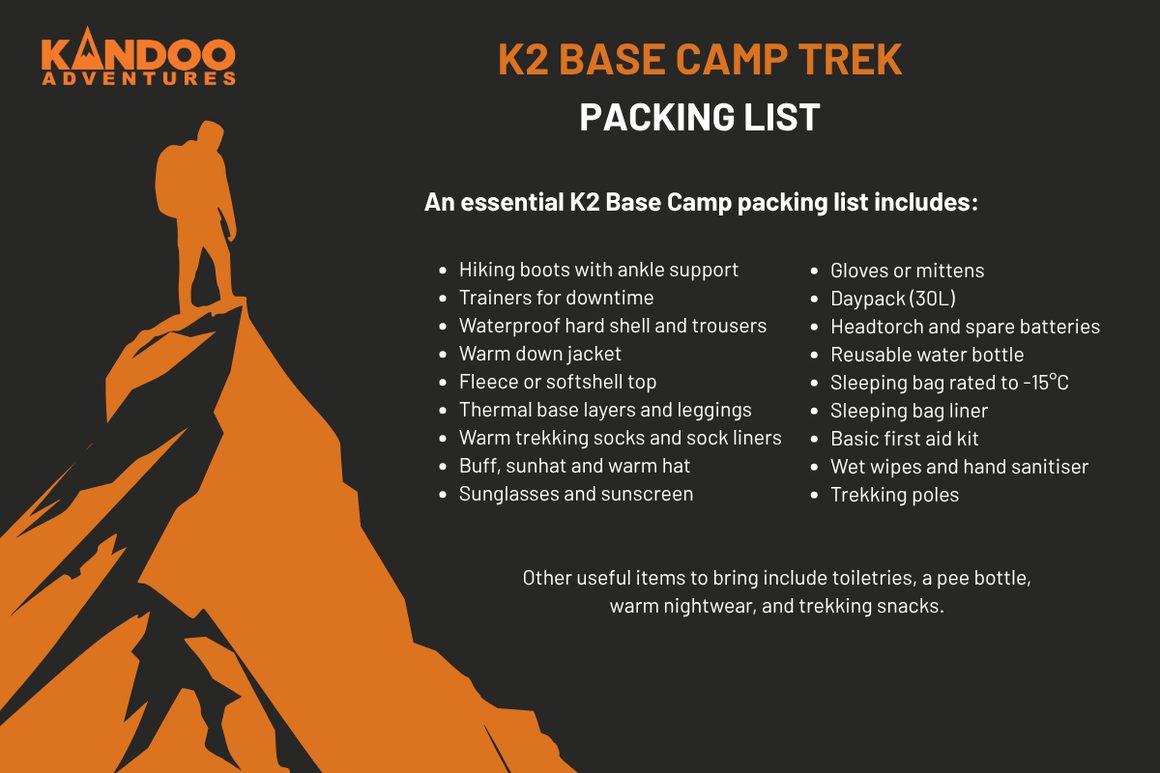
From sweltering sun early on to freezing nights camped on the ice, a layering system is essential for coping with conditions in the Karakoram.
Weight allowances
Mountain flights to Skardu have strict weight limits and luggage should be no more than 20kg plus 7kg for your daypack.
Your porters will carry your main bag during your trek, but you need to carry your own daypack. Excess luggage can be left at Skardu or in Islamabad.
Side note: Only take what you need to avoid overloading the porters with unnecessary weight, and don’t forget to tip them at the end
Permits and visas
Foreign travellers to Pakistan usually require an entry visa. British and American visitors need 6 months validity in their passport and 2 blank pages. Travellers from other countries need to check the entry requirements for their nationality.
You must apply for a Pakistan trekking visa online in advance. There are no visas issued on entry, so you must be granted permission before you travel.
It can take up to 4 weeks for visa approval, so allow enough time to include the possibility of delays.
In addition to a valid visa, you also need trekking permits for the Karakoram National Park. Your tour provider will usually apply for these on your behalf and include the price within your trip cost.
Trekking season
The best time to trek to K2 Base Camp is July and August. Daytime temperatures will be warm at Askole and mild at Concordia, with overnight temperatures falling to -10°C/14°F. The Karakoram mountains don’t experience the same monsoonal rains as Nepal and Bhutan, but storms can appear at any time of year.
From mid-June to September, the days are long, generally clear and the climate is mild, making it the best time for trekking to K2 Base Camp.
Travel insurance
Most tour operators require you to have travel insurance before the trek. At Kandoo, for example, we require all travellers to have insurance that covers you to an altitude of 6,000m. In the unfortunate incidence of an accident, rescue operations in the Karakoram can be expensive so adequate cover is essential.
Essential preparation and training for K2 Base Camp
We recommend training for at least six months in advance of your K2 Base Camp trek with a mixture of cardio, strength and altitude training. Try climbing progressively higher peaks, on consecutive days ideally, and aim for as many treks at altitude as possible before you go.
Excellent training treks include:
If you have completed either of these adventures and are looking for your next challenge, K2 Base Camp should definitely be on your radar.
Completing the K2 Base Camp trek successfully requires an excellent level of fitness and a determined mindset. Those who prepare adequately beforehand will be better equipped to deal with the physicality of this journey.
Side note: Bear in mind that you’ll be camping for much of your trip, toilet facilities are basic, and you’ll travel through remote regions. This trek isn’t a comfortable, easy adventure. It’s a gritty, tough slog among the highest mountains in the world.
K2 Base Camp: Safety, guides, and local expertise
Behind every successful K2 Base Camp trek is a local team of Balti porters, guides, cooks, and support staff. They carry luggage, tents, food, facilities, and equipment to make camp and provide meals in the wild Karakoram mountains.
The knowledge and experience of local guides make our trips stand out. We don’t import Western guides, we employ local people with the expertise to confidently lead our guests.
Every trip has comprehensive risk assessments, safety management systems, and plans in place for all eventualities. The remote nature of this region makes rescue missions challenging.
We plan our itineraries carefully to include acclimatisation days, vet all guests to make sure they’re prepared, and keep groups small to ensure high guide to guest ratios. These measures minimise the most common risks to give every trek the highest possible chance of success.
FAQs about K2 Base Camp trek
Are there alternatives to the K2 Base Camp trek?
If the uneven terrain, unpredictable weather and required amount of training sound unappealing, there are plenty of alternative treks available.
A few of our recommendations include:
- Everest Base Camp, Nepal: A more established trekking route, similar altitude but shorter distance and daily trekking duration
- Tour du Mont Blanc, France: A less remote, lower altitude, but with iconic alpine scenery
- W Trek, Patagonia: A lower altitude, fewer visitors, wild and remote scenery, great trekking adventure
Recommended reading: Find out more about K2 vs Everest.
Is trekking to K2 Base Camp a mountaineering expedition?
No, this trek isn’t a mountaineering expedition. Although terrain can be loose, uneven, and prone to rock fall, you don’t need climbing or technical skills.
What is the Gondogoro La Pass?
Returning from K2 Base Camp via the Gondogoro La Pass is an optional detour that adds a couple of days to your itinerary. The exceptionally beautiful landscapes of this valley, coupled with the chance to try out your mountaineering skills, make it an irresistible add-on for many.
Consider the Gondogoro Valley route if;
- You want to explore a remote and untouched wilderness
- You have a good level of fitness
- You want to learn some mountaineering skills
- You value the cultural significance of exploring this special region
Do you need prior mountaineering experience to reach K2 Base Camp?
You don’t need prior mountaineering experience to trek to K2 Base Camp. You only need ice axes, crampons, helmets, and ropes for trekking through the Gondogoro La Pass, which not all itineraries include. Although this part of the route is challenging, no prior experience is necessary.
Can I trek to K2 Base Camp solo?
No, the government in Pakistan requires all foreign trekkers to be accompanied by an approved guide and solo treks are not permitted.
How crowded is the K2 Base Camp route?
Although the K2 Base Camp height is similar to that of Everest Base Camp, there are far fewer people on the trails in Pakistan than in Nepal. You’re likely to have camps to yourself, even during trekking season, and will meet few travellers on the route.
Is the K2 Base Camp trek worth the cost?
Yes, definitely! Although less famous than its EBC counterpart, the K2 Base Camp trek arguably offers much more exciting scenery, a more interesting journey with no crowds. For a seriously off-the-beaten-path experience, we think this trek is unbeatable for high mountain scenery.
Plan your K2 Base Camp Trek with Kandoo Adventures
Reckon you’re up for the challenge?! By now you should have a good idea of whether this adventure is a bit of you.
Get in touch with our friendly team at Kandoo HQ to discuss your K2 Base Camp trek in Pakistan. We’ll answer your questions, advise on training and help you plan a successful trek through the breathtaking Karakoram mountains of Pakistan.