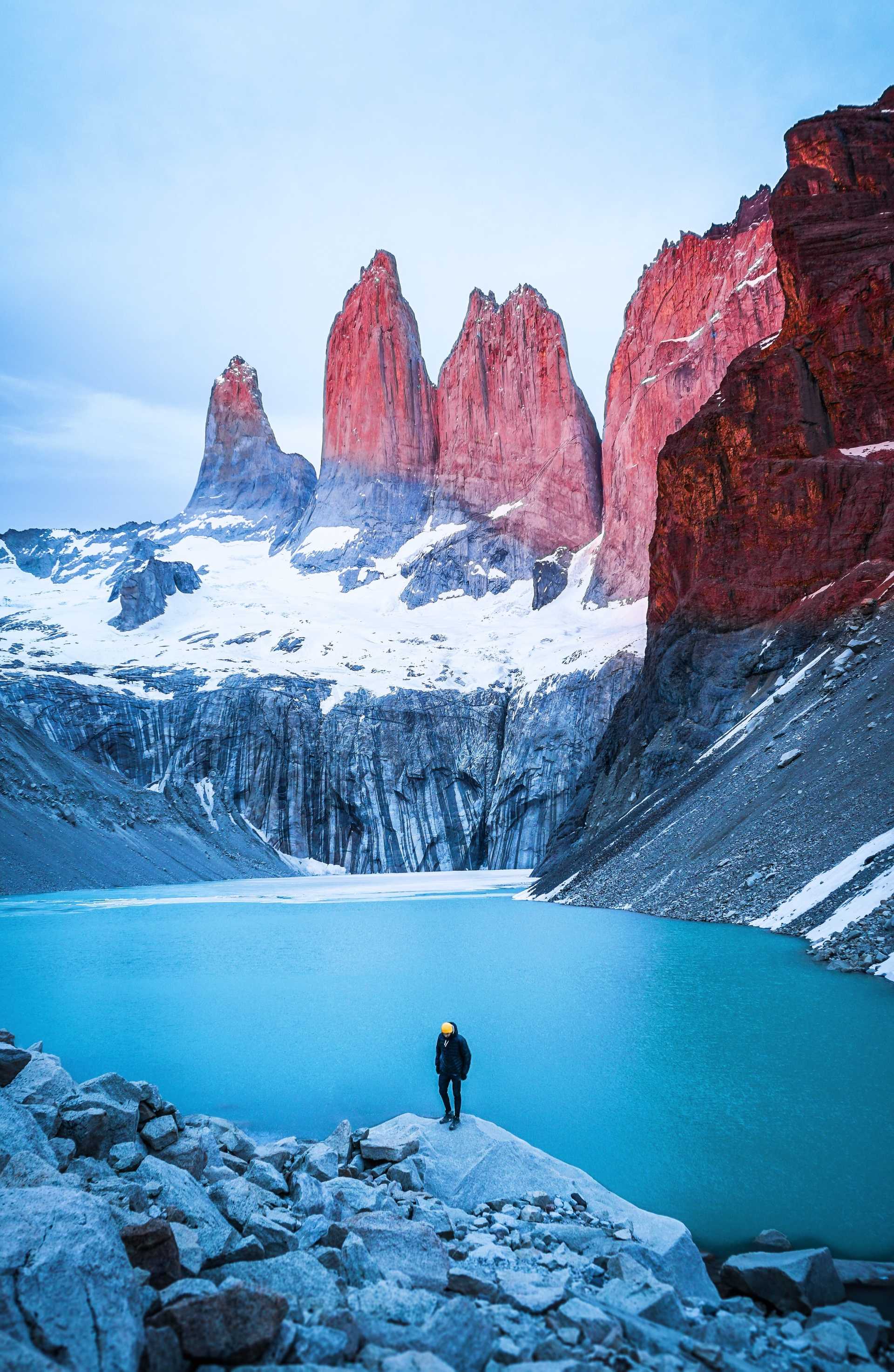
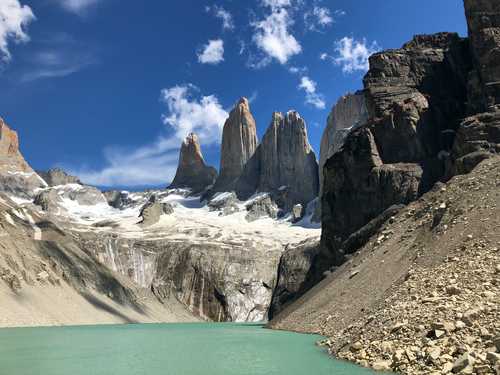
Man standing on rock in Torres del Paine National Park

Chile travel guide

Chile FAQs

  • Is Chile safe to visit right now?

    Absolutely yes. Like anywhere in the world there is always the chance of petty theft, but trekking in Patagonia is very safe in both Argentina and Chile.
  • Do British citizens need a visa for Chile?

    UK passport holders do not require a visa to enter Chile. On arrival you will be granted a maximum 90 day stay in the country. On arrival in Chile the immigration authorities will issue you with a 'Tarjeta de Turismo - Tourist Card'.
  • Which airport do you fly into for Patagonia?

    For those taking on the W or O treks, we will pick you up from Puerto Natales Airport (code PNT) in Chile. If you are taking on our longer Peaks of Patagonia tour, then you will need to fly to El Calafate (code FTE). For our Ultimate Patagonia tour you will start your trip in Buenos Aires with a night spent in Argentina's vibrant capital.
  • When is the best time of year to go to Chile?

    The best time to visit Patagonia is during the summer months of December to February. At this time, you can expect daytime temperatures between 6 °C and 20 °C. Night time temperatures could go as low as 0°C.
    The more northern parts of Chile stay warm throughout the year so they are a good option when Patagonia is under snow. 
  • Is Chile expensive?

    In comparison to other South American countries Chile is quite expensive. However, if you are happy avoiding the posh restaurants and eating in the same places as the locals using set lunch menus you will find prices aren't too bad. Transport is also relatively inexpensive. 
  • How much does a trip to Patagonia cost?

    This really depends on what you want to do while you are in the region. The refuges and campsites can be expensive so it is a good idea to join a group and share the costs. Take a good look at what is included in the price of your trip.  On our Ultimate Patagonia trip we include accommodation in Buenos Aires at the start and end of your tour as well as domestic flights to Ushuaia and loads of other experiences such as boat trips, city tours, airport transfers and meals.  These make this trip more expensive than the likes of our O and W Treks which are predominantly trekking trips. However we think the important thing is to look for value for money, not just the lowest price. 
  • How long does it take to hike Patagonia?

    Patagonia is a huge region that covers parts of Argentina and Chile, how much time you need really depends on what you want to see and do. Our Peaks of Patagonia trip is 15 days and includes the big, iconic trekking routes in Torres del Paine and the Fitz Roy region. Our O Trek is shorter, taking 10 days and completing another famous route in the Torres del Paine area. Our W Trek is the shortest route we offer, a 6 day trip in total, which makes it a perfect inclusion to a longer trip. 
  • What do I need to know before travelling to Chile?

    • Chilean Spanish and taught Spanish are two very different languages and English is widely spoken. 
    • You don't need a visa to travel to Chile from the UK or the US.
    • Chile is an extremely long, narrow country so it can take a while to get between locations. 
    • It lies over a tectonic hot zone and therefore earthquakes are common in Chile. 
    • Mealtimes are later, particularly evening meals, as Chileans enjoy embracing a late night.  
  • How many days should you spend in Chile?

    A minimum of a week is really necessary to be able to experience some of the wonders Chile has to offer. If time isn't a constraint then indulge in two weeks or a month for a full Chilean cultural tour. 

Trekking Patagonia

  • When can you hike in Patagonia?

    The best time to visit Patagonia is during the summer months of December to February. At this time, you can expect daytime temperatures between 6 °C and 20 °C. Night time temperatures could go as low as 0°C.
  • How much does a trip to Patagonia cost?

    This really depends on what you want to do while you are in the region. The refuges and campsites can be expensive so it is a good idea to join a group and share the costs. Take a good look at what is included in the price of your trip. At Kandoo Adventures we include hotel accommodation before and after your Patagonia trekking tour, domestic flights down to Patagonia and loads of other stuff such as boat trips, city tours, airport transfers and most meals.  These are things you would otherwise have to pay extra for yourself. The important thing is to look for value for money, not just the lowest price. 
  • Which airport do you fly into for your trips in Patagonia?

    Depending on which tour you have booked you will fly into different airports:
    • For our W Trek and O Circuit tours you will need to fly into Teniente Julio Gallardo Airport (PNT) in Puerto Natales.
    • For Peaks of Patagonia you will need to fly into  El Calafate Airport (airport code FTE).
    • For Ultimate Patagonia your trip will start in Buenos Aires so you will need to book a flight into Buenos Aires Ezeiza Airport (EZE).
    • If you are climbing Aconcagua, you will need to fly into Mendoza Airport (MDZ)
  • Is it safe to travel in Patagonia?

    Absolutely yes. Like anywhere in the world, there is always the chance of petty theft, but trekking in Patagonia is very safe in both Argentina and Chile.
  • Where will I be sleeping on your trekking trips?

    All trips start and end with hotel accommodation and if you are taking part in a multi-day trek, you will be spend each night at a campsite and stay in a tent. On all trips which involve camping, the tents will already be set up and your sleeping mat and sleeping bag will be provided. At most campsites, sleeping bags are laundered after each use but this is not always the case and you should bring a warm sleeping bag liner. 
  • What will I need to carry on a multi-day trek in Patagonia?

    You will need to bring everything you will need for your trek. This includes your trekking clothing, underwear, toiletries, sleeping bag liner, snacks and any personal medications. Treks such as the O Circuit and W Trek are self-supported and you will need to be comfortable carrying a backpack with all of these items in. You can find full packing lists for each trip on our trip dossiers and website. You will be able to leave anything you don't need for the trek at your hotel.  
  • What is there to do in Puerto Natales?

    In the Plaza de Armas Arturo Prat, there are a number of bars, restaurants, coffee shops and tourist agencies. The busiest streets are likely to be Eberhard, Bulnes, Baquedano and Blanco Encalada. 

    The Etherh Aike Craft Village is a bustling area of the town. With 23 local craft shops, you will be sure to find some great trinkets to remember your trip.

    The Municipal History museum (Museo Historico Municipal) is the principle museum in Puerto Natales and houses a collection of artifacts dating back to the earliest settlers and detailing the indigenous culture of this part of Patagonia.

    If you have the time, it is well worth taking the forest trail to the Serrano Glacier Viewpoint. To get to the beginning of the trail at the Balmaceda Nursery (CONAF), you must take a boat that that goes through the Seno Ultima Esperanza. The hike is around 1.8km and takes approximately 30 minutes to complete. 

    Lastly, you could head out of town to visit the Cueva del Milodon, a natural cave around 25km outside of Puerto Natales. It's easy to hire a taxi or, if you are feeling more adventurous, a bike!
  • Can I rent any trekking items in Puerto Natales?

    Yes! There are lots of rental shops in Puerto Natales and many stay open late. Whilst most of these shops are well stocked, if you are planning on renting anything for your trek, we recommend contacting the shops before your trip to reserve items and confirm their opening hours, payment terms and collection arrangements. 
  • Can I change currency in Puerto Natales?

    Yes you can but most currency exchange bureaus have inconsistent opening hours and it is best not to rely on waiting until you get to Puerto Natales to change currency. The Peso is not a closed currency and most people should be able to order it from a currency exchange where they live before they travel. If you are flying via Santiago, there is a reliable currency exchange at Santiago Airport but you should allow time to visit this when booking your flights if you plan to change money there as you may need to collect your bags and check them in again before boarding your flight. The preferred currency in Chile is the Peso.

Our blog